

Refrigerator Cabinet Dimension Guide
After looking at thousands of refrigerator cabinet photos and refrigerator spec sheets, we've become somewhat of an expert on refrigerator enclosures. In this post we will share what we've learned.
Quick Links
What size should my refrigerator cabinet be?
Refrigerator cabinet construction options
How to build a refrigerator cabinet which fits any refrigerator (and still looks great)
What size should my refrigerator cabinet be?
The answer to this is more complicated than you might think. You'd think everyone in the industry might come together and establish a standard, but unfortunately this is not the case. Refrigerator sizes and clearance requirements vary quite a bit. This leads to cabinet sizes which vary. Some real life examples might help. Below are three popular refrigerator models and the corresponding "cutout" dimension recommended in their spec sheet (this is the size of the refrigerator cabinet).
Bosch B36CL80SNS
Width & Height: 35-5/8 x 72
Recommended cutout: 72* x 36
*In the spec sheet, it shows the height of the refrigerator to be 72", but adds a note to "add 5/8" with front leveling feet fully extended".
Kitchenaid KRFC300ESS
Width & Height: 35-3/4" x 70-1/8"
Recommended cutout: 36-3/4" x 70-5/8"
Samsung RF29A9675
Width & Height: 35-7/8" x 73"
Recommended cutout: 36-5/8" x 73-3/8"
Frigidaire PRFC2383AF
Width & Height: 35-9/16" x 70"
Recommended cutout: 36-5/16" x 70-3/8"
To summarize, below are the ranges of recommended cutout dimensions using the refrigerators listed above:
Width: 36" to 36-3/4" (3/4" variation)
Height: 70-1/8" to 73-3/8" (2-1/4" variation)
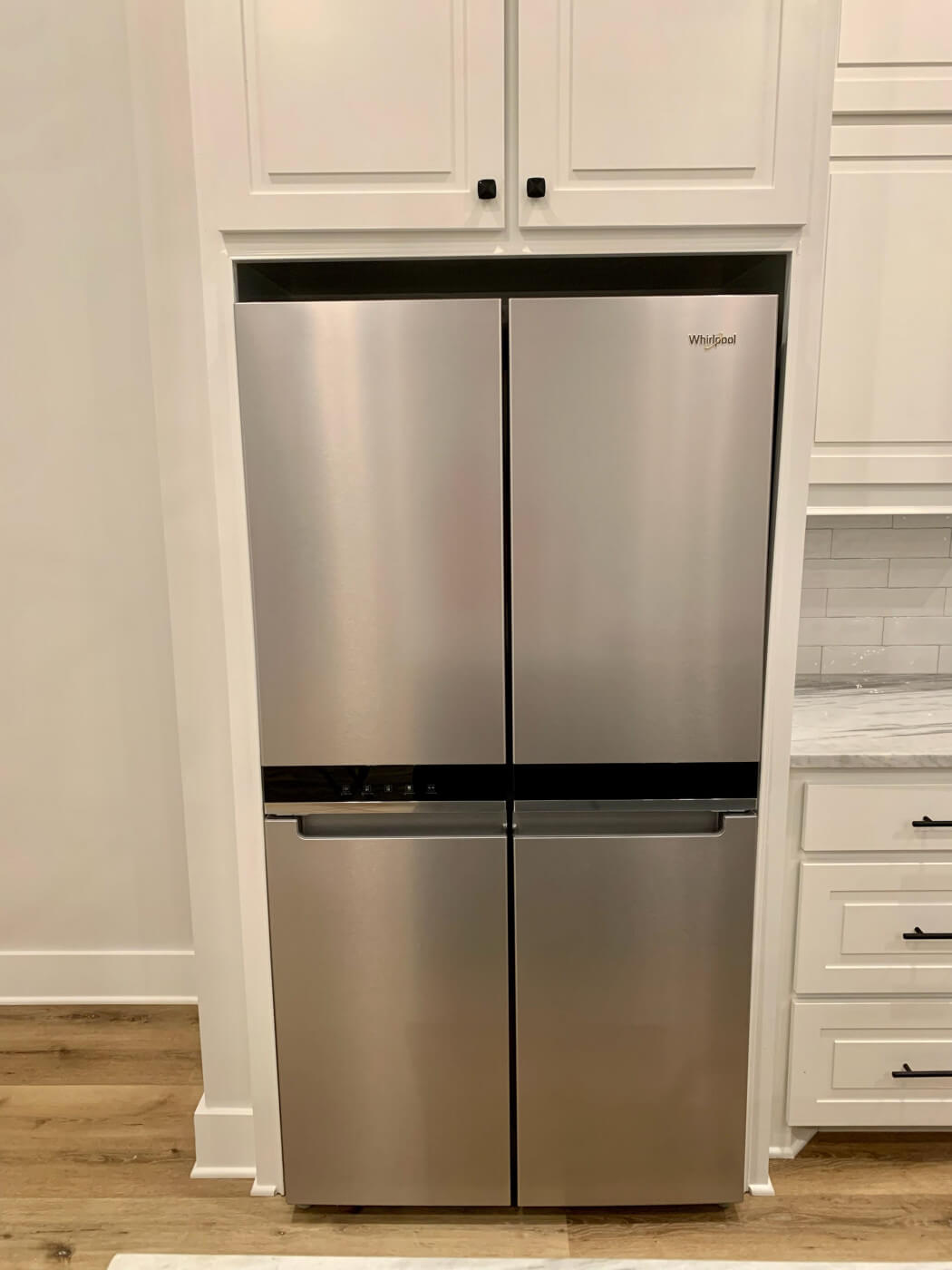
The refrigerators chosen represent the high and low end of the range and therefore we feel comfortable using them for our recommended cabinet size: 37" x 74". For depth, we recommend 25" or more for counter depth refrigerators and 30" or more for standard depth refrigerators. These dimensions will allow for most refrigerators to be installed in the opening down the road. We'll talk more about this in a bit, but the problem with building a cabinet this size is that it results in large gaps on the top and sides of the refrigerator.
Refrigerator cabinet construction options
When ordering or building cabinets, we often get asked for advice. Below is what we recommend:
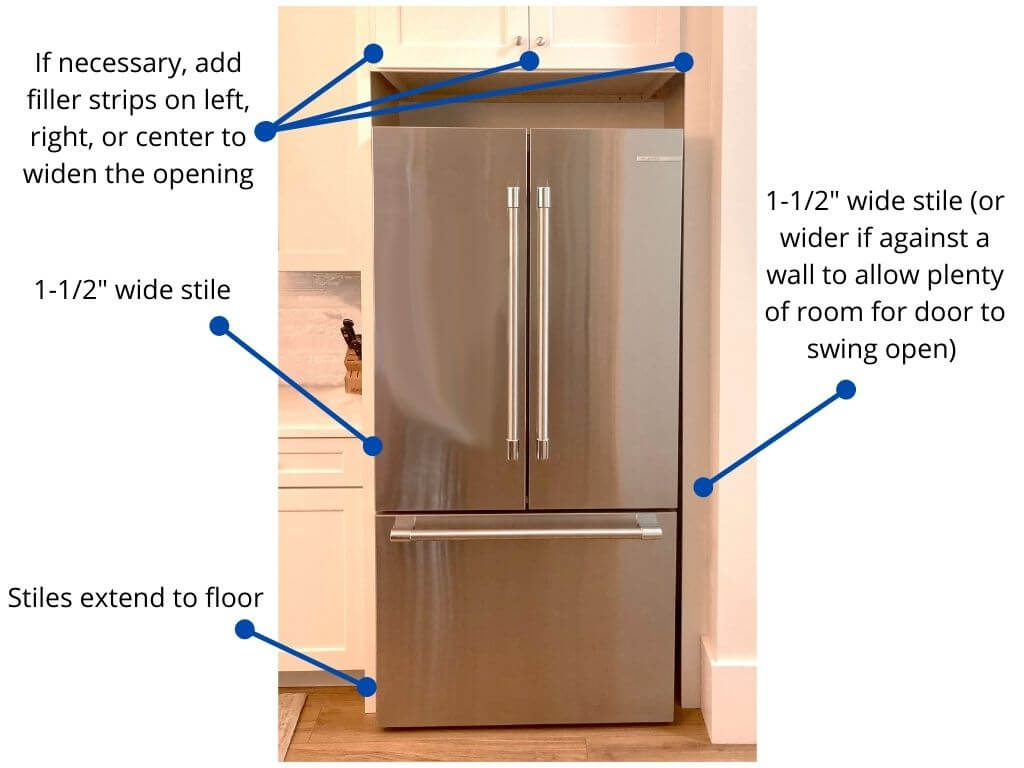
Upper cabinet: The upper cabinet is the cabinet above the refrigerator. Its width determines the width of the cabinet opening and most we see are 36" wide. If working with a custom cabinet builder, all that is necessary to change this is to let them know you'd like the upper cabinet to be 37" wide and they can design accordingly. If ordering stock cabinets, we recommend adding some filler strips to the right, left, or middle to increase the width to at least 37".
Refrigerator cabinet details: To help illustrate some details, we put together the picture below. As you can see, we recommend 1/1-2" or wider styles which run all the way to the ground. This adds some nice weight to the cabinet and allows for modifications down the road. If space is a premium in your kitchen then you can also use 3/4" wide plywood without the styles. This will provide an additional 1-1/2" of horizontal space in your kitchen.
How to build a refrigerator cabinet which fits any refrigerator (and still looks great)
As we mentioned previously, if you plan for the future and build a proper refrigerator cabinet, you will likely end up with some unsightly gaps on the sides and top. One solution is to add a refrigerator trim kit similar to the one shown below. The kit below is a "retrofit" kit and was added after the home was built. A more proactive approach would be to use one of our spec sheets and build a cabinet designed to accommodate a full height grille and side pieces.
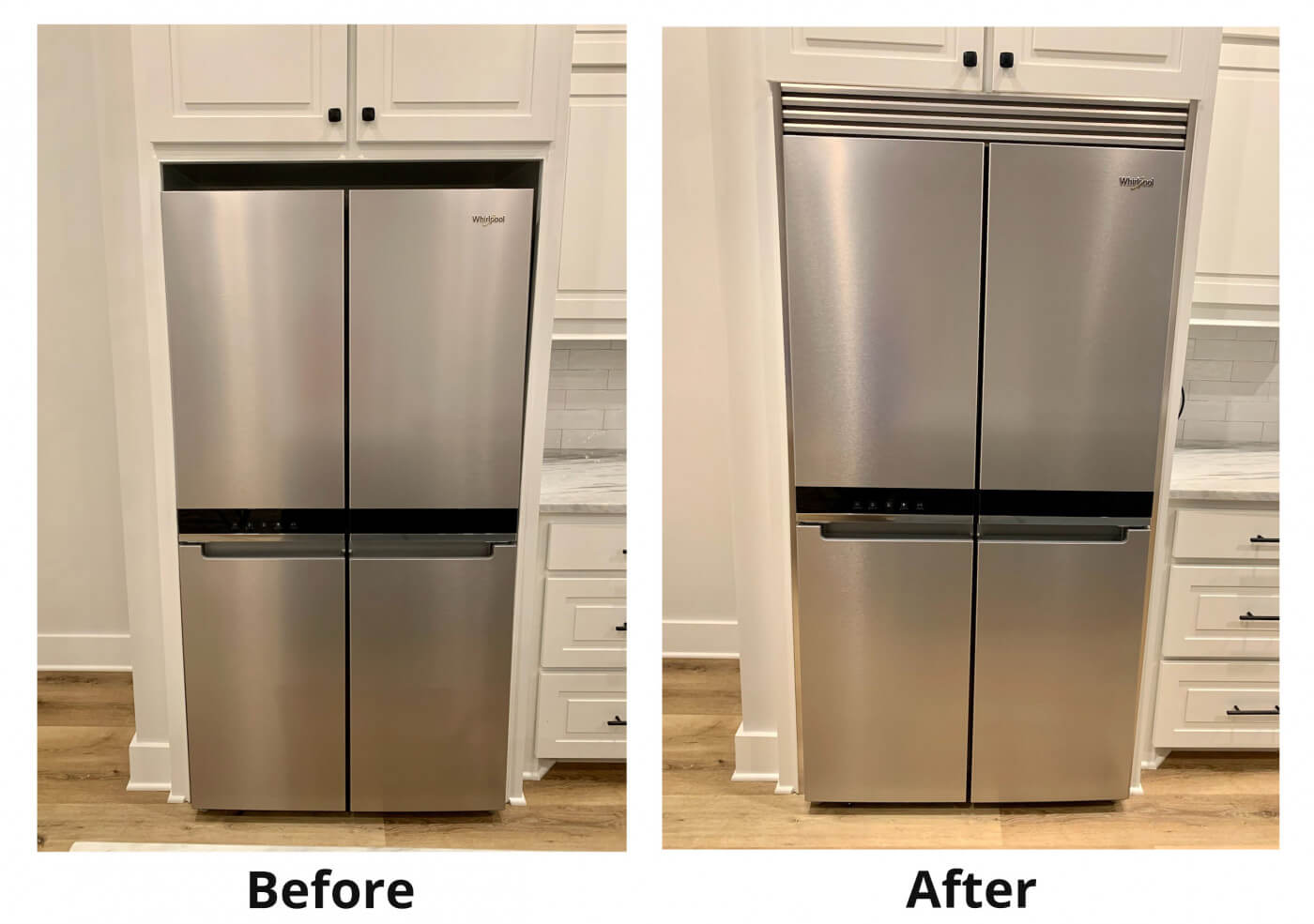
As we mentioned in our post "7 Reasons to Install a Refrigerator Trim Kit in your Kitchen"", there are several benefits to adding a kit such as this.
Conclusion
We hope this guide has been helpful. If you have any questions or need any help related to refrigerator cabinets, we are here to help.
FAQs
How deep should I build my new refrigerator cabinet so the appliance does not stick out too far?
Your cabinet needs to be deep enough to hide the painted case of the refrigerator. We recommend a minimum depth of 26 inches for counter-depth refrigerators, and a minimum depth of 32 inches for regular-depth models.
How can I size my cabinet opening so it will fit almost any standard refrigerator in the future?
We recommend designing your cabinet space using a placeholder dimension of 76-78 inches tall and 37 inches wide. Building your enclosure around this footprint ensures it will accommodate most freestanding refrigerators on the market if you ever need to replace your current unit.
If I am building new cabinets, exactly how much empty space should I leave around the refrigerator for the trim kit?
For new cabinet construction, we typically recommend leaving a gap of 8 inches at the top of the enclosure. This provides ample room to install a custom ventilated top grille. On the left and right, we generally recommend leaving a gap of ½ - 5/8 of an inch on each side.
Will installing a trim kit restrict the airflow clearances recommended by the refrigerator manufacturer?
We can't offer specific ventilation advice because of the many cabinet types and refrigerator models, but we can share what we've learned from years of making trim kits. Our top grilles also feature integrated slots behind the louvers for ventilation. our side trim is designed to leave a small gap around the refrigerator for ventilation as well as maintenance. if you'd like to learn more about our research and experience in regards to ventilation, please reach out.
Once the trim kit is installed, how much clearance is left between the trim and the refrigerator?
We design the kit to leave a 1/8-inch to 3/16-inch functional clearance between the top and sides of the refrigerator and the edges of the trim. This ensures the appliance has enough room to move and can be pulled in and out of the opening for cleaning or maintenance.