Do Trim Kits Work With All Refrigerators? What Homeowners Need to Know Before Buying
Table of Contents
- OEM Trim Kits vs. Custom Trim Kits
- What Makes a Refrigerator a Good Candidate
- Counter-Depth vs. Standard-Depth
- Finish Options
- Ventilation Requirements
- DIY or Professional Install?
- Frequently Asked Questions
- Can you put a trim kit around any refrigerator?
- Are refrigerator trim kits universal?
- Do trim kits block refrigerator airflow?
- What type of refrigerator works best with a trim kit?
- Can a standard-depth refrigerator use a trim kit?
- Do refrigerator trim kits increase home value?
- Can I install a refrigerator trim kit myself?
- How much space should be left around a refrigerator with a trim kit?
- Are custom trim kits better than universal kits?
- Do trim kits make refrigerators look built-in?
Do trim kits work with all refrigerators? We get asked this a lot. The short answer is yes — in almost all cases, a custom trim kit will work with your refrigerator. The one exception is when the gaps around your existing refrigerator are extremely tight and we can't fabricate a trim piece narrow enough given our tooling. That situation is uncommon, but it does come up.
Here's everything else you need to know.
OEM Trim Kits vs. Custom Trim Kits
There are two types of refrigerator trim kits, and it's worth understanding the difference.
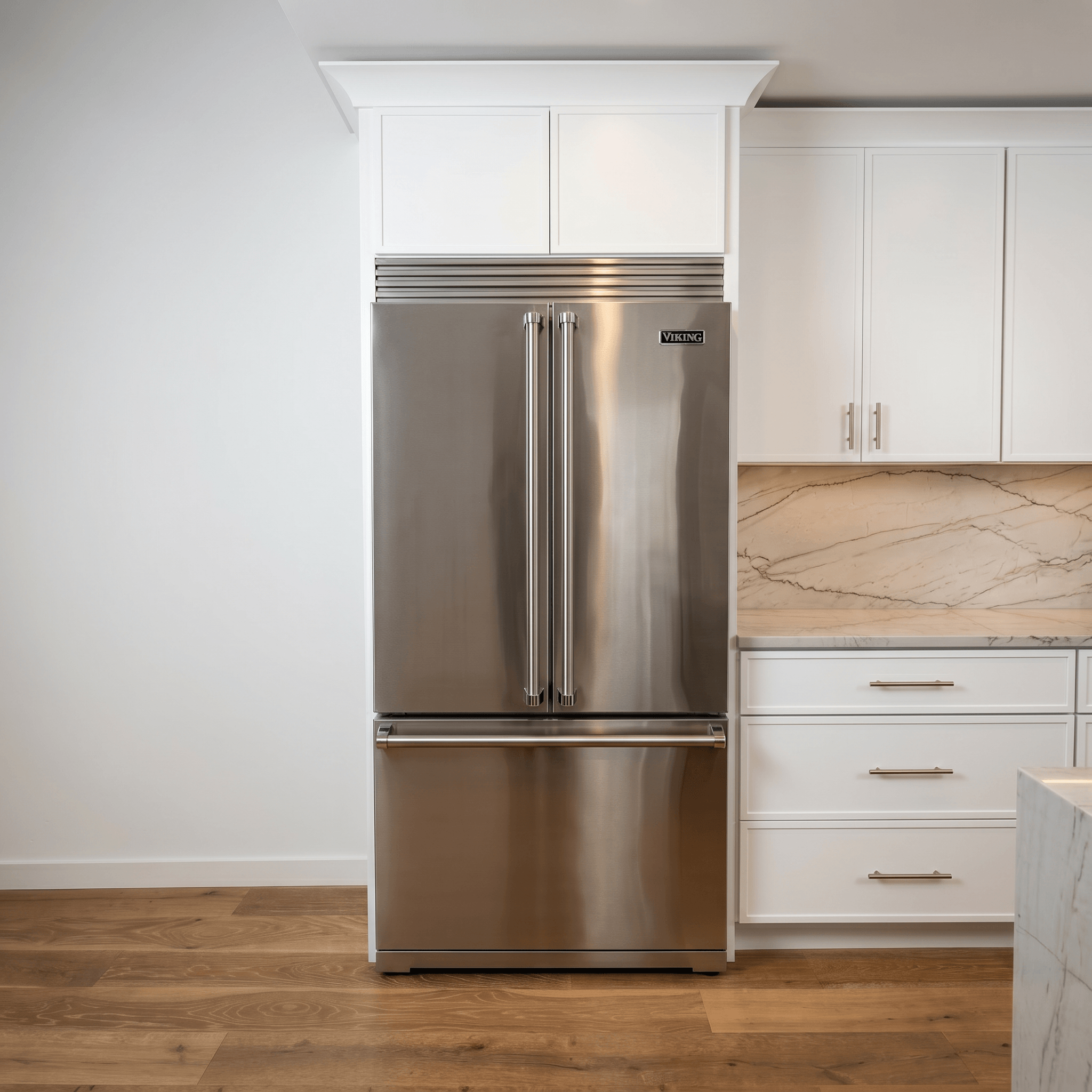
OEM trim kits come with a true built-in refrigerator — think Sub-Zero, Viking, and similar brands. These are designed for cabinets built to exact manufacturer specifications, and the appliance itself typically runs $10,000–$15,000 or more. The trim is part of an integrated, precision-built system.
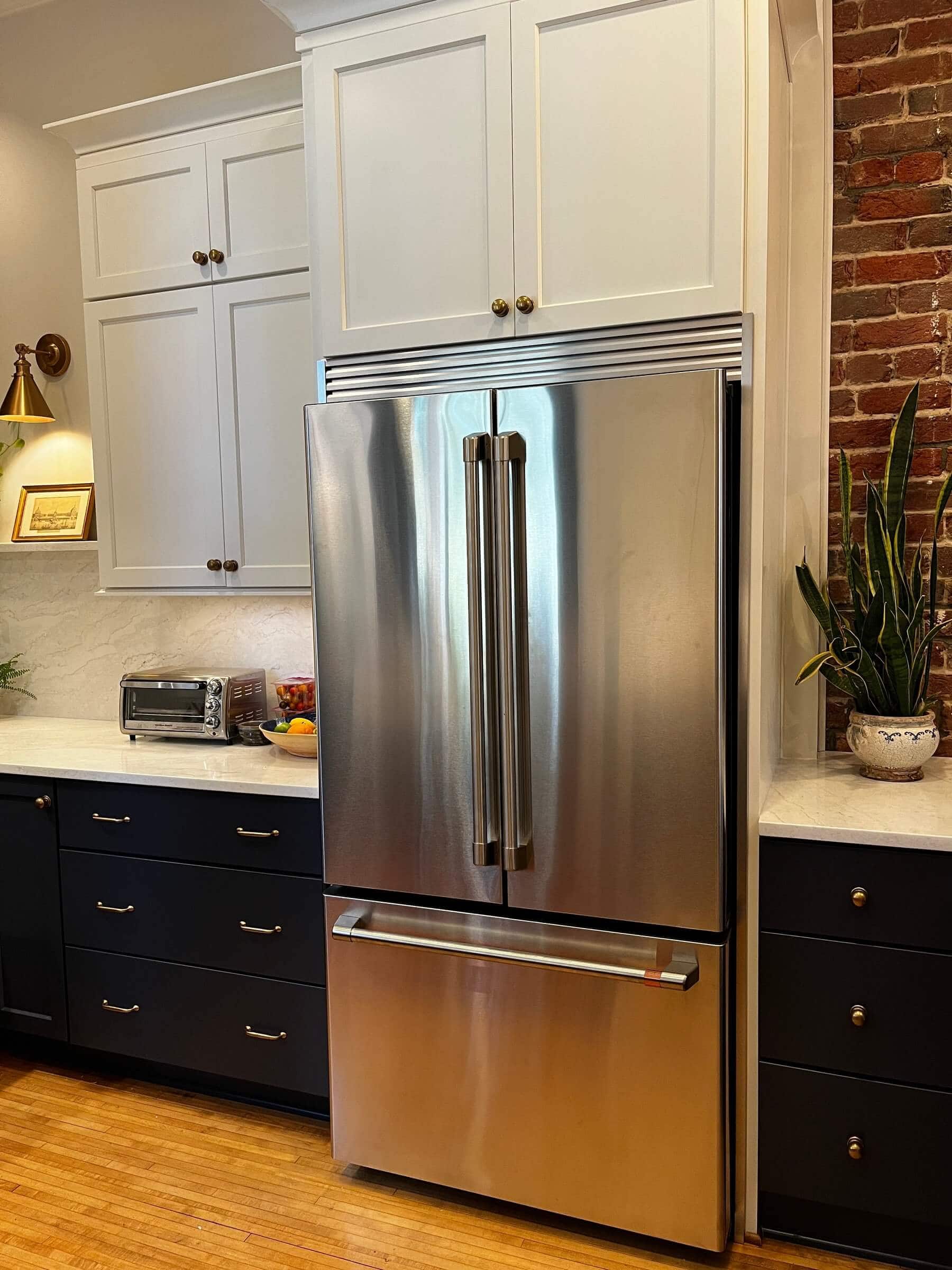
Custom trim kits — what we make — work differently. Because the kit is built to your specific measurements, the surrounding cabinetry doesn't have to be exact. There's a lot more flexibility in sizing. More importantly, a custom trim kit can be paired with virtually any refrigerator model, including standard freestanding units. Pricing ranges from roughly $1,500 to $5,500 depending on the configuration.
There are no universal trim kits. You'll see that term come up in searches, but it doesn't reflect anything that actually exists. Every kit is either OEM — made for a specific built-in appliance — or custom-made to your dimensions.
What Makes a Refrigerator a Good Candidate
Technically, we can build a trim kit for just about any model. That being said, a few things affect how the finished result looks.
What you're trying to achieve is the aesthetic of a Viking or Sub-Zero. To get there, look for:
Square geometry and clean lines — refrigerators with flat door fronts and square corners
Low-profile handles — curved or heavily projecting handles contrast with the trim and break the built-in look
Door thickness — some refrigerators have very thick doors that protrude significantly into the kitchen; thinner doors sit closer to the face frame
One newer feature worth considering: LG has started producing models with zero-clearance hinges, meaning the doors don't need to swing out into the kitchen at all. That's a nice option if door swing is a concern in your space.
All that said — we've made trim kits for a lot of different models, and they all look good. These are just things to think about if you're still in the refrigerator shopping phase.
Counter-Depth vs. Standard-Depth
Counter-depth refrigerators are typically the cleanest option. They're designed to sit closer to the cabinet line, so the finished install looks more naturally integrated.
Standard-depth models work too. One approach we've seen — especially in new construction or full remodels — is to recess the refrigerator into the wall. That gets you the same built-in appearance as a counter-depth unit, but with significantly more internal storage volume. And here's something that surprises most people: standard-depth refrigerators usually cost less than counter-depth, despite having more capacity.
We also offer refrigerator side panels for standard-depth installs. The painted case of a freestanding refrigerator is visible from the side once it's framed in. Side panels cover that in matching stainless, black stainless, or matte black, giving the whole unit a more finished look.
Finish Options
We fabricate trim kits in four finishes:
Brushed Stainless — the most popular
Black Stainless
Matte Black
Satin White — particularly popular with the GE Monogram white series
Ventilation Requirements
We get asked this a lot — usually from someone who's read their refrigerator manual and noticed a clearance requirement listed somewhere.
The short answer: our trim kits are designed with airflow in mind, and we've done the testing to back it up.
Side clearances — On a standard install, we leave a 1/8" to 3/16" gap between the side trim and the refrigerator. That space serves two purposes: it lets air circulate, and it means you can still pull the unit out when you need to.
Top grille — The top grille piece isn't just decorative. It has slots along the back to allow heat to escape upward.
That being said, we wanted to understand the actual impact — not just assume it was fine. So we ran a heat transfer analysis using a flat, flush-mount trim kit. That's the worst-case scenario — no holes, no slots, maximum restriction.
A few things most people don't know going into this:
Most refrigerators are designed to operate in ambient room temperatures of 110–120°F
Our study found that adding a flat, flush-mount trim kit reduces that maximum operating temperature by about 10 degrees — so if your refrigerator's spec sheet lists a max room temp of 110°F, a trim kit brings that down to around 100°F
That said, every refrigerator model is different, and cabinet configurations vary widely. Pull your refrigerator's spec sheet and make the call for your specific setup. If you have questions, feel free to reach out — we're happy to talk through it.
DIY or Professional Install?
Every kit ships with all mounting hardware and a detailed installation video. The only tools you typically need are a tape measure and a cordless screwdriver.
Installation usually takes 15 to 30 minutes. A lot of people do it themselves without any issues. If you're not particularly handy, hiring a carpenter or handyman is a perfectly reasonable option — it's not a complex job for someone with basic skills.
Frequently Asked Questions
Can you put a trim kit around any refrigerator?
In most cases, yes. The only situation where it doesn't work is when the gaps around the refrigerator are so tight that we can't produce a trim piece narrow enough with our shop tooling. That's not common, but if you've got a very tight install, send us your measurements and we'll let you know.
Are refrigerator trim kits universal?
No — there's no such thing as a universal trim kit. Every kit is either OEM (built for a specific true built-in appliance) or custom-fabricated to your measurements. Custom is almost always the right answer for a freestanding or standard refrigerator.
Do trim kits block refrigerator airflow?
Our kits are designed to maintain adequate airflow. We leave side clearance on every install, and the top grille is vented to allow heat to escape. We've also done testing on this — see the ventilation section above for the full explanation.
What type of refrigerator works best with a trim kit?
Counter-depth models tend to give the cleanest result because they sit closer to the cabinet line. That being said, standard-depth refrigerators work well too — especially if you can recess the unit into the wall, which gets you more storage and a better visual result, often at a lower appliance cost.
Can a standard-depth refrigerator use a trim kit?
Yes. You can recess it into the wall for a true built-in look or install it flush and use side panels to cover the exposed case on the sides. Either approach works.
Do refrigerator trim kits increase home value?
We think so. Built-in refrigeration is a feature in most luxury homes. When you add that look to a mid-range kitchen, it noticeably raises the perceived quality of the space — and that tends to translate when buyers are evaluating the home.
Can I install a refrigerator trim kit myself?
Yes. Every kit comes with all hardware and a step-by-step installation video. You'll need a tape measure and a cordless screwdriver. Most installs are done in 15 to 30 minutes.
How much space should be left around a refrigerator with a trim kit?
We leave 1/8" to 3/16" on the sides as standard. That maintains airflow and allows you to pull the refrigerator out when needed. Top clearance is handled by the vented grille piece. If you have a specific configuration you're unsure about, reach out and we can walk through it.
Are custom trim kits better than universal kits?
There are no universal refrigerator trim kits — that's a misconception. Your options are OEM (for true built-in appliances that run $10K+) or custom. Custom is what allows you to use any refrigerator model and accommodate real-world cabinetry that isn't built to a perfect specification.
Do trim kits make refrigerators look built-in?
Yes. That's the whole idea. A well-fitted trim kit closes the gaps between the refrigerator and surrounding cabinetry and gives the appliance the appearance of an integrated, custom installation. You can see examples in our gallery.
Hope that completely answers the question, "do trim kits work with all refrigerators?" If you've got a specific model or situation you're trying to figure out, feel free to reach out. We're here to help.